
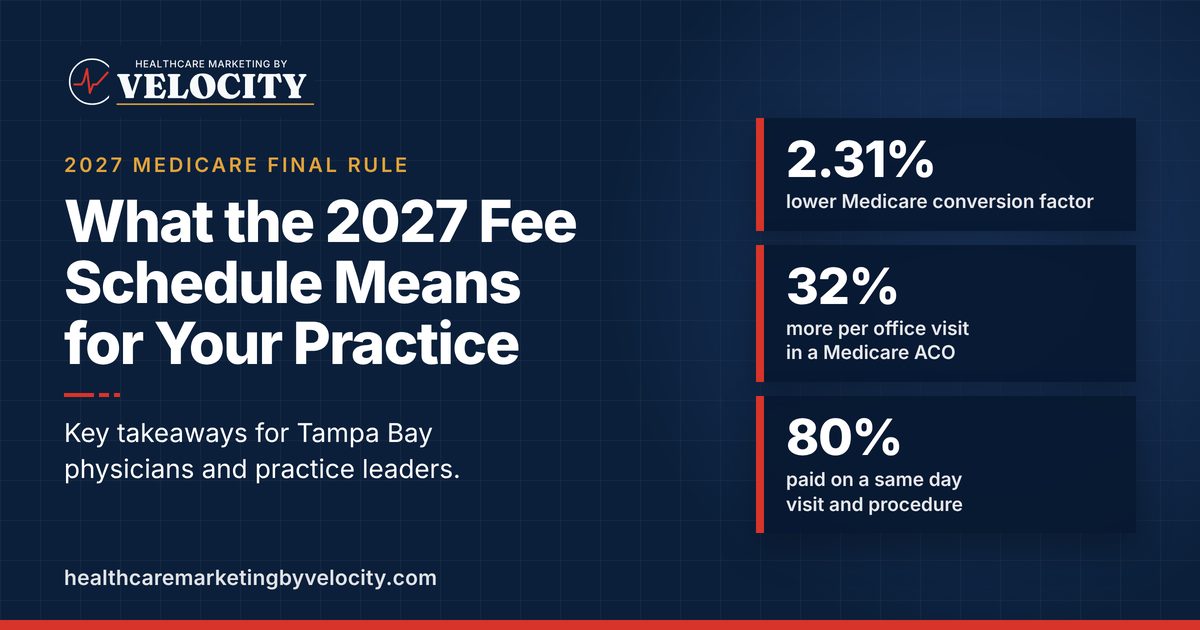
Key takeaways: the 2027 fee schedule at a glance
- Medicare pays most physicians 2.31% less per service in 2027. The conversion factor moves to $32.63 on January 1.
- Clinicians in a Medicare ACO earn 32% more on office visits with the new B2 modifier, and it applies to all of their patients.
- G2211 becomes modifier B1, adding 16% to office visits for physicians outside an ACO.
- An office visit billed the same day as a minor procedure is paid at 80%. Dermatology, ENT and podiatry feel this most.
- ACOs keep more of their savings and get steadier benchmarks, and from April 2027 approved ACOs can reduce patient cost sharing.
- Traditional MIPS ends in 2031. Plan your move to MIPS Value Pathways or an ACO now.
- Coaching, group visits, smoking cessation and behavioral health assessments now pay more or gain new billing pathways.
- Act before January: review your payer mix, your ACO options and your new patient pipeline.
Download the Printable Guide (PDF)One page, with a 2027 readiness checklist to share with your team.
What CMS finalized and when it takes effect
The Centers for Medicare & Medicaid Services (CMS) released the calendar year 2027 Physician Fee Schedule final rule on November 4, 2026. It sets how Medicare pays physicians and other clinicians for services in 2027, and it also updates the Medicare Shared Savings Program, the Quality Payment Program and several payment policies.
Most provisions take effect January 1, 2027. One notable exception: the new option for approved ACOs to reduce patient cost sharing begins April 1, 2027. CMS received more than 44,000 public comments on the July proposal, and the final rule changed several proposals in response, most visibly the same day visit and procedure policy.
The direction is clear. CMS is paying less per service under traditional fee for service while rewarding clinicians who participate in accountable care. For practices, that turns 2027 into a planning year for ACO participation, payer mix and patient growth.
How much does Medicare physician pay change in 2027?
The 2027 conversion factors, the dollar amount each relative value unit is multiplied by, as finalized by CMS.
| Clinician group | 2026 conversion factor | 2027 conversion factor | Change |
|---|---|---|---|
| Most physicians and clinicians (not qualifying APM participants) | $33.40 | $32.63 | 2.31% lower |
| Qualifying APM participants | $33.57 | $32.95 | 1.83% lower |
Why the conversion factor is lower
The main reason is the end of a one year 2.5% increase that applied only to 2026. Statutory updates of 0.25% for most clinicians and 0.75% for qualifying APM participants offset part of that, and a work RVU adjustment of about 0.12% lowers it slightly. The final cuts are larger than the July proposal, which estimated 1.68% and 1.19%.
Your actual change depends on your specialty and services. CMS also finalized a practice expense overhaul that phases out the indirect practice cost index over two years and adds a stabilizer to limit swings. Trade press reports larger decreases for dermatology, otolaryngology, orthopedic surgery and hand surgery, and increases for clinical psychologists and clinical social workers.
What is the B2 modifier? The 32% ACO office visit increase explained
B2 is a new modifier for office and outpatient evaluation and management (E/M) visits. It is available to clinicians who participate in a Medicare Shared Savings Program ACO or are participant providers in the Long-term Enhanced ACO Design (LEAD) Model. Appending B2 to the visit code increases the visit payment by 32%.
Three details make B2 especially important:
- It applies to all of the clinician's patients, not only patients assigned to the ACO.
- It is voluntary. Practices decide whether to use it.
- B2 claims count toward ACO beneficiary assignment and toward the ACO's benchmark and performance year spending, so ACO leaders will want to plan for it.
For a primary care or internal medicine practice that bills many office visits, the difference between 16% (B1) and 32% (B2) on each visit makes ACO participation a much larger financial decision in 2027 than it was before.
G2211 becomes modifier B1
The office visit complexity add on code G2211 is replaced by modifier B1, appended to the E/M base code. B1 increases the visit payment by 16% across all office visit levels. Practices that used G2211 for longitudinal care relationships should update templates, charge capture and billing workflows before January 1.
The same day visit and procedure rule, and who it affects most
When a separately identifiable office visit, usually billed with modifier 25, happens on the same day as a procedure with a 0 day global period, the higher paid service is paid in full and the other is paid at 80%.
The final rule is much narrower than the proposal. CMS had proposed paying the second service at 50% and extending the policy to 10 and 90 day global procedures. Both were dropped after public comment.
Specialties that often pair an exam with a minor procedure feel this most, including dermatology, otolaryngology and podiatry. For these practices, steady new patient volume and a healthy mix of services matter more in 2027.
Shared Savings Program changes: should your practice join an ACO in 2027?
The final rule makes the Medicare Shared Savings Program more rewarding and more predictable for ACOs. The main changes:
| Change | What CMS finalized | When |
|---|---|---|
| Higher shared savings rate | BASIC Level E rises from 50% to 60%. ENHANCED stays at 75% | 2027 |
| Benchmark savings adjustment | Scaling factor rises from 50% to 75%, easing the rebasing ratchet on successful ACOs | 2027 |
| Growth adjustment | Rewards ACOs that recruit clinicians who are new to value based care | 2027 |
| More predictable spending targets | A guardrail keeps the prospective trend within 1 point below to 1.5 points above national growth | Agreements starting 2027 |
| Patient cost sharing | Approved ACOs may reduce or waive Part B cost sharing for many services for assigned patients. Applications open early 2027 | April 1, 2027 |
| B2 office visit modifier | 32% higher office visit payment for ACO clinicians | January 1, 2027 |
| Advance investment payments | Flat quarterly amounts of $45 per eligible higher need or rural beneficiary and $25 for others | 2028 |
| Prepaid shared savings | Option removed because of low uptake | 2027 |
What the ACO changes mean for independent practices
CMS reports that 75% of the 476 ACOs in the program earned shared savings for performance year 2024, totaling $4.1 billion. The 2027 rule builds on that by raising savings rates, softening benchmark rebasing and rewarding growth.
If your practice is not in an ACO today, 2027 is the year to compare your options. If you already participate, it is the year to look at track and level choices, how B2 billing affects your benchmark, and whether cost sharing reductions could help your patients choose and stay with your practice. ACOs applying for a January 1, 2027 start may still adjust their track or level during CMS's request for information period.
MIPS, the Ambulatory Specialty Model and remote monitoring
- MIPS: traditional MIPS reporting ends beginning with the 2031 performance period, two years later than proposed. Clinicians have through 2030 to move to MIPS Value Pathways, which CMS says cover about 98% of clinicians, or to Advanced APMs. New pathways cover diabetes, hypertension and hospitalists, and clinicians must report at least one specialty specific core measure starting in 2027.
- Ambulatory Specialty Model: this CMS Innovation Center model launches January 1, 2027 and holds participating specialists accountable for the quality and cost of care for heart failure and low back pain. It matters most for cardiology, orthopedics and pain management.
- Remote monitoring: remote therapeutic monitoring is limited to established patients, and an initiating visit is required when remote physiologic or therapeutic monitoring begins. The requirement that services be performed by the billing practice's own clinical staff is delayed to January 1, 2029.
Prevention, behavioral health and care planning
The rule adds several opportunities for primary care and behavioral health practices:
- National payment pathways for health and wellbeing coaching under general supervision.
- Dedicated billing for shared medical appointments, with time based add on codes.
- Higher values for smoking and tobacco cessation and behavioral health assessments, plus increased work values for the Psychiatric Collaborative Care Model.
- Two new advance care planning codes for clinical staff working under direct supervision.
- Separate billing for the clinical time needed to evaluate and counsel patients with vaccine adverse effects.
Group visits and coaching can expand access and patient engagement, which supports both fee for service revenue and value based care goals.
Plan your 2027 payer mix and value based care strategy
Book a free discovery call with Justin Miller and get a clear plan for ACO participation, payer mix and new patient growth before rates change on January 1.
What this means for Tampa Bay practices
For physicians across Tampa, St. Petersburg, Clearwater, Brandon, Wesley Chapel and Pasco County, the 2027 rule points to four priorities:
- Make the ACO decision with the B2 difference in mind. A 32% visit increase for ACO clinicians, compared with 16% under B1, changes the math for primary care, internal medicine and multi specialty groups. Compare the ACOs available to you on support, track options and how they share savings with practices.
- Review your payer mix now. Practices with a large Medicare patient base feel the conversion factor change most directly. Many commercial and Medicare Advantage contracts are priced as a percentage of the Medicare fee schedule, so check how yours are written, and look for the services and patient groups where your practice can grow.
- Grow new patient volume to protect revenue. When the rate per visit changes, the number of patients you serve matters more. A steady pipeline of the right patients, measured from first call to completed visit, is one of the most reliable ways to protect revenue. See our patient acquisition approach and Tampa Bay healthcare marketing work.
- Use the time before January well. Update charge capture for B1, B2 and the same day rule, align your team on the changes, and set 2027 growth targets that account for the new rates.
Healthcare Marketing by Velocity is based in Tampa and works with physicians, practice owners and healthcare organizations across Florida on practice growth, payer mix and value based care strategy.
2027 readiness checklist
A short list to work through with your partners, administrator and billing team before January 1.
- Ask your billing team how B1, B2 and the same day rule apply to your top codes
- Estimate your 2027 Medicare revenue at the new rates
- Review your payer mix: Medicare, Medicare Advantage, commercial and self pay
- Decide whether to join, stay in or change ACOs
- Plan your MIPS Value Pathway or Advanced APM move before 2031
- Set new patient growth targets that cover the rate change
About this guide
This guide is educational and reflects the CMS final rule as published on November 4, 2026. It is not billing, coding or legal advice. Confirm coding and billing decisions with your billing team and your Medicare Administrative Contractor. We will update this page as CMS publishes the full rule in the Federal Register and additional guidance.
FAQ
2027 Physician Fee Schedule FAQs
When does the 2027 Medicare Physician Fee Schedule take effect?
Most provisions take effect January 1, 2027. The option for approved ACOs to reduce patient cost sharing begins April 1, 2027, and some Shared Savings Program changes begin in 2028.
What is the 2027 Medicare conversion factor?
$32.63 for most physicians and clinicians, 2.31% lower than $33.40 in 2026. For qualifying APM participants it is $32.95, 1.83% lower than $33.57.
What is the B2 modifier?
B2 is a new 2027 modifier for office and outpatient visits billed by clinicians in a Medicare Shared Savings Program ACO or the LEAD Model. It increases the visit payment by 32% and can be used for all of the clinician's patients. B2 claims count toward ACO assignment and spending calculations.
What happened to G2211 in 2027?
G2211 is replaced by modifier B1, which is appended to the office visit code and increases payment by 16% across all visit levels.
How does the same day office visit and procedure rule work in 2027?
When a separately identifiable office visit and a 0 day global procedure happen the same day, the higher paid service is paid in full and the other is paid at 80%. It does not apply to 10 or 90 day global procedures.
When does traditional MIPS end?
Traditional MIPS reporting ends beginning with the 2031 performance period. Clinicians have through 2030 to move to MIPS Value Pathways or Advanced APMs.
Should my practice join an ACO in 2027?
It depends on your patient panel, specialty, the ACOs available in your market and how they share savings. The 2027 rule makes ACO participation more valuable through the 32% B2 visit increase, higher shared savings rates and steadier benchmarks. Book a free discovery call to talk through your options.
Services
Related healthcare marketing services
Patient Acquisition
Full funnel patient acquisition marketing that connects demand, conversion, intake and capacity so growth is measured in first visits, not clicks.
Analytics and Reporting
Privacy-aware measurement for healthcare marketing: GA4, Tag Manager, call tracking, CRM connections, attribution and dashboards leaders can use.
Medical Practice Marketing Tampa
Practice level marketing for Tampa Bay physicians: maps, paid search, website conversion, reviews, call tracking and appointment measurement.
Resources
Healthcare marketing guides

How Much Should a Medical Practice Spend on Marketing
How to set a medical practice marketing budget from your own goals: patient acquisition math, percentage of revenue, competitive context, cost drivers and phasing.

How to Calculate Patient Acquisition Cost
Formulas for blended and channel level patient acquisition cost, fully loaded vs media only, lifetime value, payback and the data you need to trust the numbers.

How to Evaluate Healthcare Marketing ROI
Formulas for ROI, ROAS and cost per acquired patient, attribution models and their limits, data sources, privacy-aware measurement and a reporting cadence.
Sources and further reading
- CMS: Calendar Year (CY) 2027 Medicare Physician Fee Schedule Final Rule (fact sheet)
- CMS: CMS Finalizes CY 2027 Physician Fee Schedule (press release)
- American Hospital Association: CMS issues CY 2027 physician fee schedule final rule
- Medical Economics: Medicare’s final 2027 fee schedule cuts physician pay more than proposed
- Chief Healthcare Executive: CMS’ final 2027 physician fee schedule cuts pay and reworks ACO incentives
- Becker’s Hospital Review: CMS deepens 2027 physician pay cut to 2.31%
External sources are provided for context. Marketing guidance on this site is not legal advice.